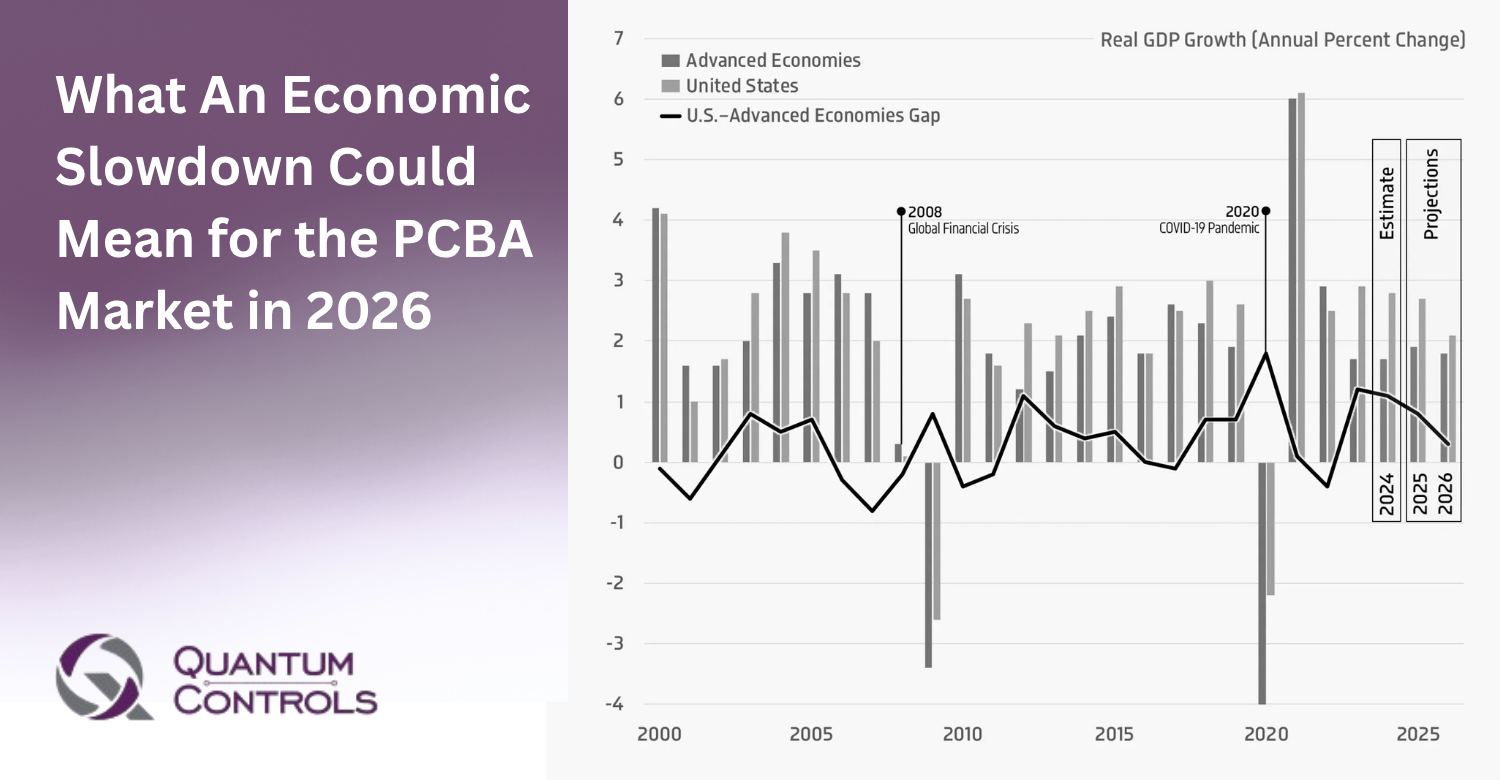
Forecast models for 2026 suggest that the U.S. economy could slow, with some analysts predicting a mild recession and others anticipating a soft landing. For companies in the electronics manufacturing sector, this raises a critical question: how will a potential downturn impact the Printed Circuit Board Assembly (PCBA) market?
At Quantum Controls, we’ve been evaluating how macroeconomic trends might influence our customers, our suppliers, and the manufacturing ecosystem that ties them together.
1. Demand Will Moderate, Not Disappear
If growth slows, the first signs typically appear in the consumer electronics and telecom sectors. Historically, these markets have been the most price-sensitive and inventory-heavy.
By contrast, industrial controls, medical instrumentation, aerospace, defense, and automotive systems tend to maintain more stable demand due to regulatory requirements and safety-critical applications.
These sectors, which comprise a significant share of Quantum Controls’ customer base, are likely to continue requiring consistent, high-reliability PCBAs even during a mild recession.
2. Production Cycles and Book-to-Bill Ratios
In any slowdown, OEMs often adjust purchasing behavior:
- Shorter order cycles replace long-term forecasts.
- Inventory drawdowns temporarily reduce new build requests.
- Book-to-bill ratios may decline, particularly in high-volume markets.
EMS and PCBA suppliers with flexible capacity, diversified customer mixes, and strong cash discipline generally recover faster once demand normalizes. Quantum Controls has prioritized all three, with adaptive scheduling, cross-trained assembly teams, and real-time production visibility.
3. Supply Chain Positioning Still Favors North America
Even in a downturn, reshoring and nearshoring continue to influence sourcing decisions. Tariff uncertainty, logistics volatility, and quality assurance concerns have driven many OEMs to seek U.S.-based manufacturing partners for PCBAs.
We’ve seen this shift firsthand. Customers are prioritizing design collaboration, shorter lead times, and higher traceability, particularly in areas where domestic manufacturing adds tangible value.
4. Strategic Response at Quantum Controls
To prepare for potential economic tightening in 2026, Quantum Controls is:
- Strengthening Design for Manufacturability (DFM) services to help OEMs lower unit costs through design optimization.
- Increasing focus on industrial, where reliability and compliance requirements remain strong regardless of market cycle.
- Enhancing supply chain resilience, including multi-sourcing critical components and monitoring lead-time variability.
- Maintaining lean operations to preserve price competitiveness and flexibility during potential demand shifts.
Outlook
Even if the economy slows, electronics content per product continues to rise, especially across vehicles, machines, and smart systems. That structural growth means the PCBA industry is positioned for long-term expansion, with only short-term cyclical adjustments.
Quantum Controls will continue to partner with customers to navigate these shifts intelligently, striking a balance between design innovation, cost efficiency, and manufacturing reliability.
Learn more about our PCBA capabilities at https://quantum-controls.com/capabilities/