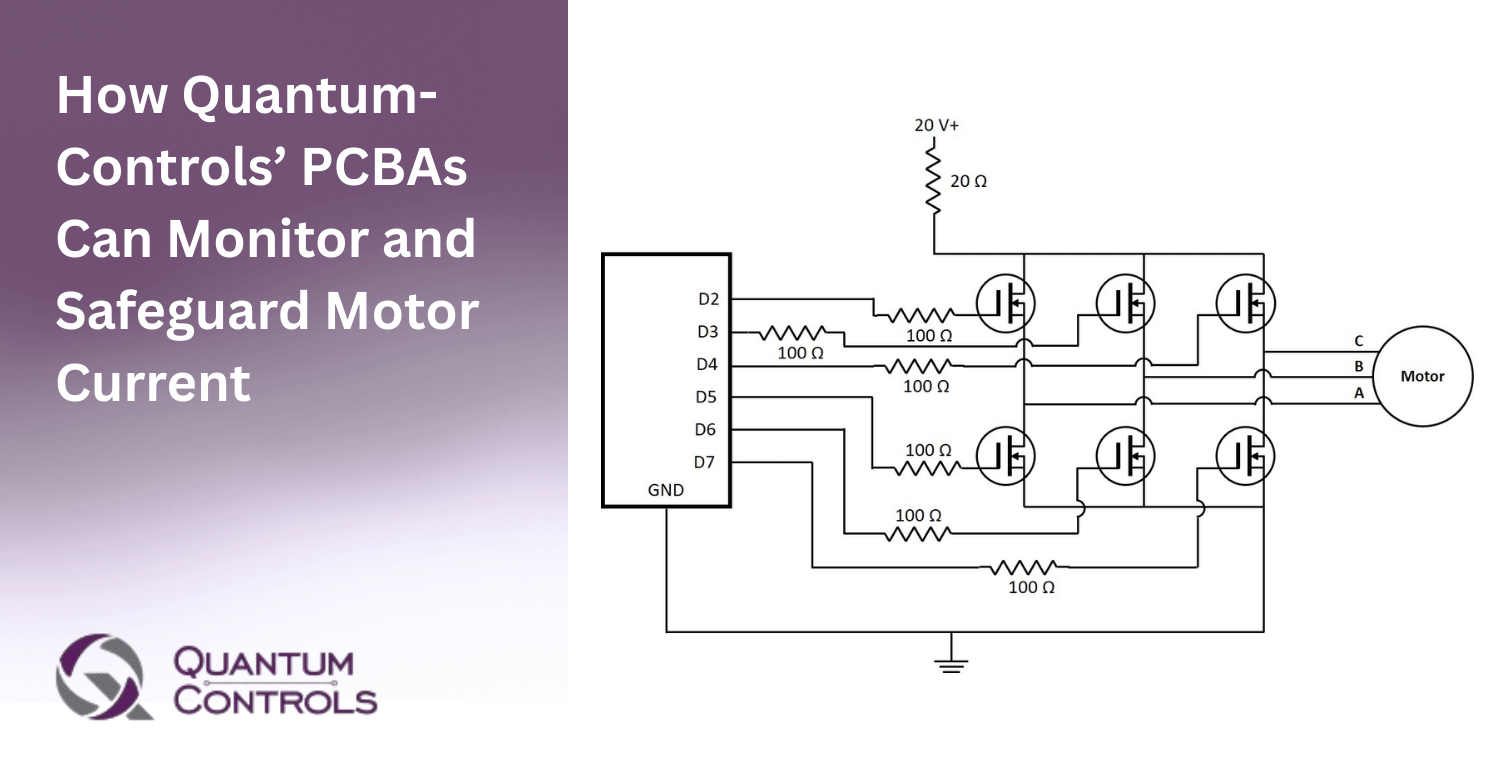
In advanced motor control systems, safety and performance depend on motor feedback. At Quantum Controls, we design and manufacture intelligent PCBAs that not only drive motors efficiently but also listen to them. One of the most valuable signals for feedback and protection comes from the motor itself: back electromotive force (back EMF).
What Is Back EMF?
When a motor spins, it naturally generates a voltage opposite to the direction of the applied voltage; it’s called back EMF. It’s proportional to the motor’s speed and provides real-time insight into the load, torque, and overall system health.
How PCBAs Use Back EMF
Modern PCBAs integrate sensing and signal conditioning circuitry that monitor back EMF from the motor windings. When paired with onboard microcontrollers and intelligent firmware, these boards can:
- Estimate Motor Speed: By analyzing the voltage on unpowered phases during PWM cycles, the PCBA determines rotor position and speed without using physical sensors.
- Monitor Load Conditions: Changes in back EMF indicate varying torque or load on the motor, allowing for adaptive control.
- Safeguard Against Overcurrent and Stall Events: When a motor stalls, back EMF drops suddenly while current rises sharply. The PCBA detects this mismatch in milliseconds and automatically reduces power or shuts down to prevent component damage.
Why This Matters
Traditional systems rely solely on current sensors or external monitoring devices. By using back EMF as part of a smart feedback loop, PCBAs can predict and prevent faults, enhancing efficiency, safety, and lifespan without additional hardware.
Inside the Design
Quantum Controls’ PCBA designs integrate:
• Passive measurement op-amps for accurate sensing and low interference
• High-speed ADC sampling set to the midpoint to account for both directions of the motor
• Real-time firmware algorithms for back EMF analysis and protective control
• Robust protection circuitry that isolates logic from power transients
The result is a self-aware control system, one that not only drives performance but actively safeguards it.
At Quantum Controls, we continue to advance PCBA technology that bridges power, intelligence, and protection in our board designs.
Learn more about our PCBA capabilities at https://quantum-controls.com/capabilities/