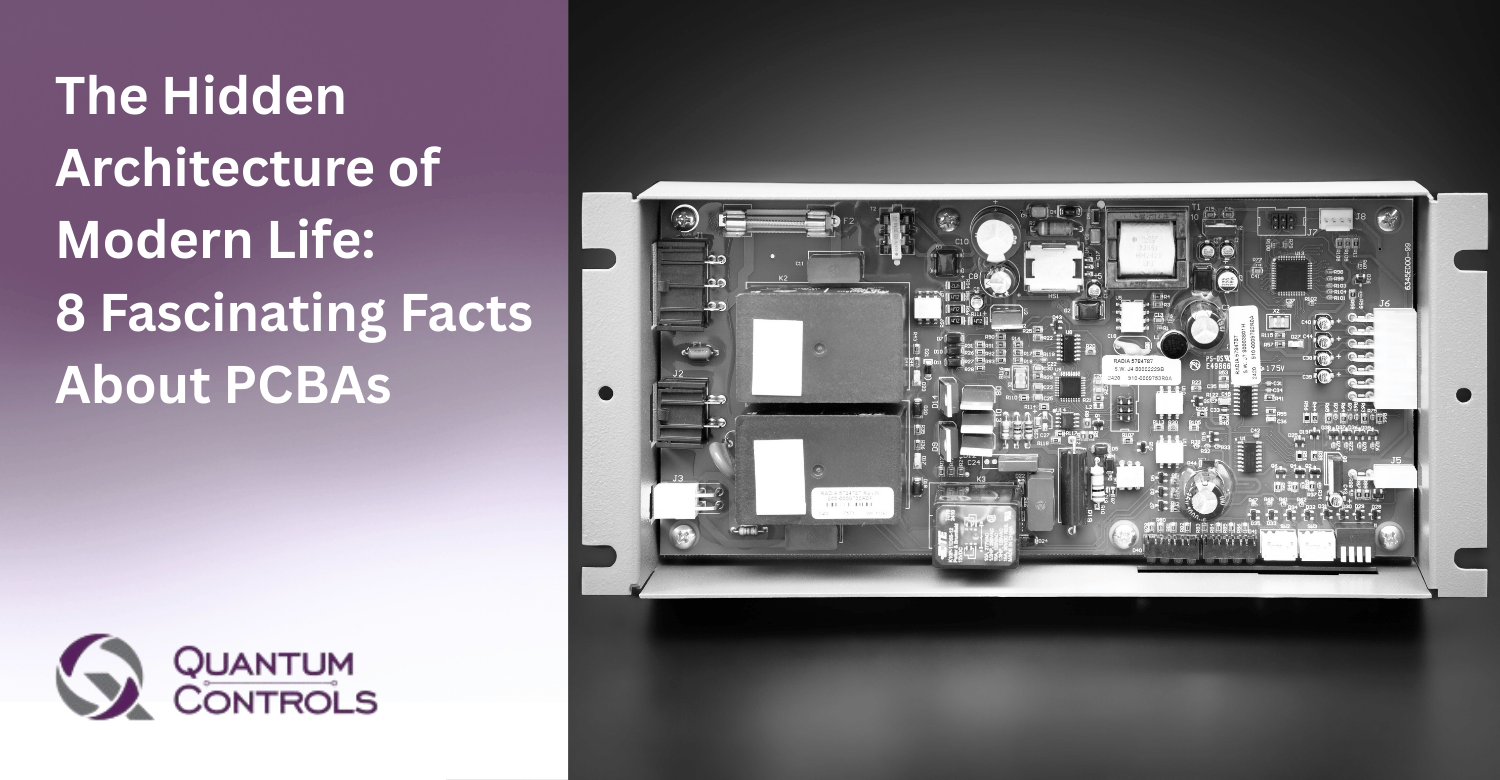
If you were to peel back the casing of almost any modern device, from a smart thermostat to an industrial control system, you would find something unassuming yet extraordinary: a printed circuit board assembly, or PCBA.
These compact assemblies quietly power our connected world. While they rarely get attention outside engineering circles, PCBAs represent one of the most sophisticated intersections of design, physics, automation, and craftsmanship in modern manufacturing.
Here are eight fascinating insights into the world of PCBAs and why they matter more than most people realize.
1. A PCBA Is Where Design Becomes Reality
It is worth clarifying a common misconception. A PCB, printed circuit board, is the bare board. A PCBA is the fully assembled board, populated with components, soldered, inspected, and tested.
That transformation, from a fiberglass and copper substrate into a functioning control system, is where theory meets execution. Schematics, layouts, simulations, and component selections all converge into something tangible and operational.
A PCBA is not just hardware. It is engineering brought to life.
2. Modern Components Are Almost Invisible
Miniaturization has pushed manufacturing precision to extraordinary levels. Some passive components used today, such as 01005 resistors, measure roughly 0.4 mm by 0.2 mm. They are smaller than a grain of sand.
At that scale:
- Solder paste volume must be precisely controlled
- Placement accuracy must be within microns
- Inspection systems must detect defects invisible to the naked eye
What looks like a simple green board is actually a landscape of microscopic structures assembled at remarkable speeds.
3. Speed and Precision Go Hand in Hand
Modern surface-mount technology (SMT) enables automated pick-and-place machines to position tens of thousands of components per hour.
But speed alone is not the story.
Each placement must be:
- Precisely aligned
- Properly soldered
- Thermally profiled during reflow
- Verified through inspection
High-speed automation does not replace expertise. It demands it. Process control, programming, material handling, and thermal management all determine whether a board simply looks complete or truly performs reliably.
4. The Real Complexity Is Often Inside
Some advanced PCBAs contain 12, 16, or even 20 or more layers of copper routing compressed into a few millimeters of thickness.
These multilayer boards may include:
- Blind and buried vias
- Controlled impedance traces
- Differential pair routing
- Power and ground planes for signal stability
In high-speed applications, signals behave less like simple electrical currents and more like electromagnetic waves. At that point, material selection, dielectric properties, and trace geometry become mission-critical.
What appears flat and simple on the outside is, in reality, three-dimensional electrical architecture.
5. Testing Can Be More Demanding Than Assembly
In high-reliability industries such as medical, aerospace, defense, and industrial automation, testing often accounts for a significant portion of the total production process.
Common validation methods include:
- Automated Optical Inspection, AOI
- X-ray inspection for hidden solder joints such as BGAs
- In Circuit Testing, ICT
- Functional testing under simulated real-world conditions
Building the board is only part of the responsibility. Proving it performs consistently and under stress is where quality truly reveals itself.
6. PCBAs Operate in Extreme Environments
PCBAs do not just live inside climate-controlled offices. They function in:
- High vibration industrial systems
- Electric vehicles
- Oil and gas environments with extreme temperatures
- Medical implants requiring biocompatibility
- Spacecraft exposed to radiation
Each environment reshapes the design requirements. Material selection, conformal coatings, thermal management, and ruggedization strategies-like specialized enclosures or coatings-must align with the board’s mission to ensure durability and performance in extreme conditions.
The margin for error can be incredibly small.
7. Heat Is the Quiet Enemy
Thermal management is a crucial aspect of PCBA design, as effective heat dissipation directly impacts component lifespan and system stability, highlighting the importance of meticulous engineering.
Poor heat dissipation can lead to:
- Reduced component lifespan
- Performance instability
- Premature system failure
Solutions often include thermal vias, copper pours, heat sinks, metal core substrates, or active cooling strategies. Managing heat is not an afterthought. It is a fundamental design priority.
8. PCBAs Power Modern Civilization
It is easy to overlook something so compact. But PCBAs sit at the core of:
- Industrial control systems
- Renewable energy infrastructure
- EV battery management systems
- Medical imaging devices
- Communication networks
- Everyday consumer electronics
They are the quiet enablers of modern life.
The Craft Behind the Circuit
What makes PCBAs most compelling is this. They represent a convergence of disciplines.
- Electrical engineering
- Materials science
- Precision manufacturing
- Automation
- Quality systems
And behind all of it are people—engineers designing for performance. Technicians ensuring process control. Inspectors safeguarding reliability.
A finished PCBA may disappear inside an enclosure, never to be seen again. But its impact is felt every time a system boots, a signal transmits, or a control panel responds exactly as intended.
In many ways, PCBAs are the hidden architecture of our technological age, small in scale and massive in consequence.
And for those who design and build them, that is something worth appreciating.
FAQs
Q: What is the difference between a PCB and a PCBA?
A: A PCB (Printed Circuit Board) is the unfinished board—fiberglass, copper traces, and vias—before any components are added. A PCBA (Printed Circuit Board Assembly) is the completed version, populated with electronic components that have been soldered, inspected, and tested. This is where engineering design becomes functional hardware, transforming a schematic into a dependable, working system.
Q: Why is precision so critical in PCBA manufacturing?
A: In modern electronics, precision is everything. Many components used today are smaller than a grain of sand, meaning placement tolerances are measured in microns. Even slight solder misalignment or excess paste can lead to open circuits or solder bridges. High-accuracy surface mount technology (SMT) equipment, combined with process control and optical inspection, ensures every component lands exactly where it belongs—supporting long-term reliability and performance.
Q: What makes multilayer PCBAs so complex?
A: Multilayer PCBAs often contain 12 to 20 internal copper layers, each routing signals that must maintain specific electrical characteristics. These layers include blind and buried vias, power and ground planes, and controlled impedance traces for high-speed signals. As signal frequencies rise, electrical behavior starts to resemble electromagnetic wave propagation, making material selection and layer stack-up design essential to achieving the desired electrical performance.
Q: How are PCBAs tested to ensure quality and reliability?
A: Testing is where quality is proven. Comprehensive PCBA testing may involve Automated Optical Inspection (AOI), X-ray analysis for hidden joints like BGAs, In-Circuit Testing (ICT) for component-level verification, and functional testing that simulates real-world conditions. These steps verify solder integrity, signal continuity, and operational performance—ensuring the board performs consistently before being integrated into its final system.
Q: How do PCBAs withstand extreme environmental conditions?
A: Depending on their application, PCBAs must survive vibration, temperature extremes, corrosion, and radiation. To ensure durability, engineers may apply conformal coatings, integrate thermal vias or heat sinks, and select materials rated for specific environmental stresses. Whether in aerospace, medical, or industrial automation systems, effective thermal management and ruggedization strategies are vital to long-term stability and safety.